When shopping for light bulbs, you've probably noticed a number labelled as "lumens" on the packaging. But what do lumens actually mean, and how do you know how many you need?
If you've ever wondered why some LED bulbs seem brighter than others despite using less energy, the answer lies in lumens.
At Zico Lighting, we help homeowners, businesses, electricians, and facilities managers choose the right lighting solutions every day. In this guide, we'll explain what lumens are, why they matter, and how to choose the right brightness for your home, workplace, or commercial project.
Quick Answer: What Are Lumens?
Lumens (lm) measure the brightness of a light bulb. Unlike watts, which measure energy consumption, lumens tell you how much visible light an LED lamp produces. The higher the lumen rating, the brighter the light output. Whether you're choosing decorative filament bulbs, replacing household lighting or specifying commercial LED lamps, understanding lumens makes it easier to select the right brightness for every space.
At Zico Lighting, our LED lamps range from approximately 70 lumens to 780 lumens, providing solutions for everything from decorative accent lighting to everyday room illumination.
For example:
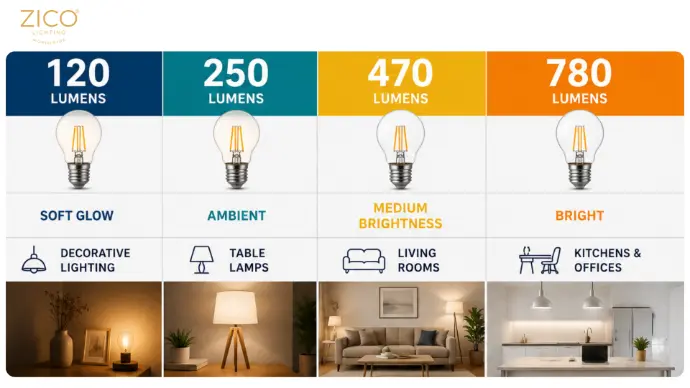
- 120 lumens = Decorative or ambient lighting
- 250 lumens = Soft mood lighting
- 470 lumens = Similar to a traditional 40W bulb
- 780 lumens = Bright general-purpose lighting
Years ago, consumers relied on wattage to estimate brightness. However, with the rise of energy-efficient LED technology, wattage no longer accurately reflects light output. When choosing modern LED lighting, lumens are a much more useful measurement than watts.
Lumens vs Watts: What's the Difference?
One of the most common misconceptions is that watts determine brightness.
In reality:
- Watts measure energy consumption
- Lumens measure brightness
For example, a traditional 60W incandescent bulb and an LED bulb may both produce similar brightness levels, but the LED uses significantly less energy.
This is why modern lighting products focus on lumens rather than wattage.
Traditional Wattage to Lumens Guide
| Traditional Bulb | LED Equivalent | Approximate Lumens |
|---|---|---|
| 15W | 2–3W LED | 120–150lm |
| 25W | 3–4W LED | 220–250lm |
| 40W | 5–6W LED | 450–470lm |
| 60W | 7–9W LED | 800lm |
| 75W | 10-12W LED | 1,050lm |
What Lumen Levels Does Zico Lighting Offer?
At Zico Lighting, we supply LED lamps and lighting products with a wide range of lumen outputs to suit different applications.
Our range includes options from 70 lumens for subtle decorative lighting through to 780 lumens for general-purpose household and commercial lighting.
70–250 Lumens
Ideal for:
- Decorative lighting
- Mood lighting
- Accent lighting
- Display cabinets
- Feature lighting
- Vintage pendants
- Restaurants and cafes
These lower-lumen lamps create a softer, more ambient atmosphere and are perfect when brightness is not the primary requirement.
250–470 Lumens
Ideal for:
- Bedside lamps
- Table lamps
- Wall lights
- Decorative fixtures
This range provides comfortable illumination for everyday residential settings.
470–780 Lumens
Ideal for:
- Living rooms
- Hallways
- Kitchens
- Home offices
- Retail environments
- General room lighting
- Everyday decorative lighting
Bulbs within this lumen range are commonly used as replacements for traditional 40W to 60W incandescent lamps, providing excellent brightness while benefiting from modern LED energy efficiency.
How Many Lumens Do I Need?
The ideal lumen output depends on the size of the room and the type of lighting required.
The suggested values represent the total recommended light output for the room. In most homes, this is achieved using multiple light sources such as ceiling lights, wall lights, table lamps and floor lamps.
Living Room
Recommended brightness:
- 1,500–3,000 lumens
Living rooms typically benefit from layered lighting that combines ceiling lights, floor lamps, and accent lighting.
Bedroom
Recommended brightness:
- 1,000–2,000 lumens
Bedrooms often require softer, more relaxing lighting than living spaces.
Kitchen
Recommended brightness:
- 3,000–4,000 lumens
Task areas such as worktops and preparation zones benefit from brighter lighting.
Bathroom
Recommended brightness:
- 2,000–4,000 lumens
Mirror lighting and grooming areas often require higher light levels.
Home Office
Recommended brightness:
- 3,000–6,000 lumens
Good lighting can help reduce eye strain and improve productivity.
Which Lumen Output Should I Choose?
Choosing the right lumen output depends on how the light will be used.
Ask yourself:
- Is the light decorative or functional?
- Will it be used for reading or task lighting?
- Is it the primary light source in the room?
- Do you prefer softer ambient lighting or brighter illumination?
For decorative lighting, 120–250 lumens may be sufficient.
For bedside lamps and accent lighting, 250–470 lumens often provides a comfortable level of brightness.
For general household lighting, many customers prefer lamps in the 470–780 lumen range to provide clear, everyday illumination.
What Is Luminous Efficacy?
Luminous efficacy measures how efficiently a light source converts energy into visible light.
In simple terms:
The more lumens produced per watt, the more efficient the bulb.
Modern LED lamps deliver significantly more lumens per watt than traditional incandescent or halogen bulbs, helping reduce energy costs while maintaining excellent brightness. Learn more about luminous efficacy and energy rating.
Do More Lumens Always Mean Better Lighting?
Not necessarily.
While higher lumen output means greater brightness, choosing the correct brightness for the environment is important. Too few lumens can make a room feel dim and impractical. Too many lumens can create glare, discomfort, and unnecessary energy consumption.
It is also worth noting that brightness isn't everything. While lumens measure how bright a light bulb is, they're only one part of creating high-quality lighting, which also depends on factors such as colour temperature (Kelvin), Colour Rendering Index (CRI), beam angle, glare control, smooth dimming, and flicker-free performance.
A high-lumen bulb with poor colour rendering may appear bright but still make colours look dull and unnatural, while excessive glare or an unsuitable colour temperature can reduce visual comfort. That's why Zico Lighting LED lamps combine carefully balanced lumen output with CRI 95+, smooth dimming, flicker-free operation, and excellent colour consistency (SDCM <4) to deliver lighting that looks as good as it performs.
Lumens and Colour Temperature: Understanding the Difference
Many people confuse lumens with colour temperature.
They measure two completely different aspects of lighting.
Lumens
Measure brightness.
Colour Temperature (Kelvin)
Measures the appearance of the light.
For example:
- 2000K = Ultra Warm for decorative lighting, often used in restaurants and lounges
- 2200K = Vintage White for calm, ambient lighting. This colour temperature is favoured in hospitality settings and works great to add warmth to the space
- 2700K = Warm White is ideal for main light sources in living rooms, bedrooms and everyday space
- 3000+K = Cool White for commercial spaces, kitchens and offices
Two bulbs can have identical lumen ratings while producing very different lighting effects depending on their colour temperature.
Frequently Asked Questions About Lumens
What does lumen mean on a light bulb?
Lumens measure the total amount of visible light produced by a bulb. The higher the lumen rating, the brighter the bulb.
How many lumens is a 40W bulb?
A traditional 40W incandescent bulb typically produces around 470 lumens.
How many lumens is a 60W bulb?
A traditional 60W incandescent bulb typically produces around 806 lumens.
Is 780 lumens bright?
Yes. Around 780 lumens is considered bright enough for many everyday household applications and is comparable to the brightness of a traditional 60W bulb.
Are lumens more important than watts?
Yes. Lumens indicate brightness, while watts indicate energy consumption. When comparing modern LED lighting, lumens provide a much more accurate measure of performance.
How many lumens do I need for a room?
The required lumens depend on the room size and intended use. Living rooms may need 1,500–3,000 lumens combined, while kitchens and workspaces often require significantly more.
What is the difference between lumens and lux?
Lumens (lm) measure the total amount of visible light produced by a light bulb, while lux (lx) measures how much of that light reaches a specific surface or area. For example, a bulb may emit 800 lumens, but the lux level in a room will vary depending on factors such as the room size, ceiling height, beam angle, and the distance between the light source and the surface being illuminated. In simple terms, lumens measure light output, while lux measures the intensity of light where it's needed.
Can I add lumens together?
Yes. If a light fitting uses multiple bulbs, you can usually add the lumen output of each lamp to estimate the fixture's total light output. For example, a chandelier with four 200-lumen LED lamps produces approximately 800 lumens in total. Keep in mind that the perceived brightness will also depend on factors such as the fitting design, beam angle, colour temperature, room size, and surface reflectivity.
Expert Advice from Zico Lighting
Understanding lumens is one of the easiest ways to choose the right lighting for your home or business. Rather than focusing on wattage alone, comparing lumen output will help you select lighting that delivers the right brightness while maximising energy efficiency.
At Zico Lighting, we offer LED lamps ranging from 70 to 780 lumens, ensuring there's a solution for decorative lighting, ambient lighting, and everyday illumination requirements.
Whether you're replacing a single bulb, upgrading to LED lighting, or planning a commercial lighting project, our team can help you find the right solution.
Final Thoughts
Lumens are the simplest and most accurate way to understand light bulb brightness.
The higher the lumen rating, the brighter the light output.
By understanding lumens, wattage, colour temperature, and your specific lighting requirements, you can choose lighting that improves comfort, visibility, and energy efficiency.
For expert advice and quality lighting solutions, trust Zico Lighting to help illuminate your space.
Related Guides
Light Bulb Glass Shapes Explained
How to identify a light bulb base cap
Understanding Colour Temperature (CCT) and why it matters
How to choose a dimmable LED bulb